
正在加载页面…


LQCDMaster: Agentic Scientific Computing for Lattice Quantum Chromodynamics Research
Lattice quantum chromodynamics (LQCD) provides a first-principles framework for computing hadronic observables, but its practical use remains limited by the substantial expertise required to turn research motivation into reliable computing workflows. Here we present , a tool-augmented, skill-guided and domain-specialized scientific computing agent that converts natural-language LQCD research tasks into executable PyQUDA computing workflows, including measurement scripts, job-submission artifacts, execution logs and numerical outputs. The system combines agentic planning, expert-annotated LQCD skills and a deterministic Wick-contraction tool to constrain the algebraically fragile components of code generation. We evaluate on a benchmark at the forefront of scientific research, comprising 70 LQCD computing tasks, with observables covering local and nonlocal two-point functions, Wilson loops, meson and baryon three-point functions. The generated workflows exactly reproduce expert-written implementations in 63 of 70 tasks at machine precision, with three additional discrepancies attributable to convention mismatches. Across representative observables, the agent reduces implementation time from hours to minutes while preserving end-to-end numerical validation. Further, we present a typical case of -driven exploration: a lattice computation of light-cone distribution amplitudes with diagonal Wilson-line, a quantity accessible with standard methods but never before computed, and computation of the spectrum of proton, deuteron, triton, hyperon, hyperdeuteron and hypertriton. This work pioneers the paradigm of agentic scientific computing by automating the end-to-end scientific computing workflows in lattice QCD research, lowering its barrier and facilitating the exploration and verification of non-standard scientific ideas.
EDoG: Adversarial Edge Detection For Graph Neural Networks
Graph Neural Networks (GNNs) have been widely applied to different tasks such as bioinformatics, drug design, and social networks. However, recent studies have shown that GNNs are vulnerable to adversarial attacks which aim to mislead the node or subgraph classification prediction by adding subtle perturbations. Detecting these attacks is challenging due to the small magnitude of perturbation and the discrete nature of graph data. In this paper, we propose a general adversarial edge detection pipeline EDoG without requiring knowledge of the attack strategies based on graph generation. Specifically, we propose a novel graph generation approach combined with link prediction to detect suspicious adversarial edges. To effectively train the graph generative model, we sample several sub-graphs from the given graph data. We show that since the number of adversarial edges is usually low in practice, with low probability the sampled sub-graphs will contain adversarial edges based on the union bound. In addition, considering the strong attacks which perturb a large number of edges, we propose a set of novel features to perform outlier detection as the preprocessing for our detection. Extensive experimental results on three real-world graph datasets including a private transaction rule dataset from a major company and two types of synthetic graphs with controlled properties show that EDoG can achieve above 0.8 AUC against four state-of-the-art unseen attack strategies without requiring any knowledge about the attack type; and around 0.85 with knowledge of the attack type. EDoG significantly outperforms traditional malicious edge detection baselines. We also show that an adaptive attack with full knowledge of our detection pipeline is difficult to bypass it.
Weakly-Supervised Deep Learning Model for Prostate Cancer Diagnosis and Gleason Grading of Histopathology Images
Prostate cancer is the most common cancer in men worldwide and the second leading cause of cancer death in the United States. One of the prognostic features in prostate cancer is the Gleason grading of histopathology images. The Gleason grade is assigned based on tumor architecture on Hematoxylin and Eosin (H&E) stained whole slide images (WSI) by the pathologists. This process is time-consuming and has known interobserver variability. In the past few years, deep learning algorithms have been used to analyze histopathology images, delivering promising results for grading prostate cancer. However, most of the algorithms rely on the fully annotated datasets which are expensive to generate. In this work, we proposed a novel weakly-supervised algorithm to classify prostate cancer grades. The proposed algorithm consists of three steps: (1) extracting discriminative areas in a histopathology image by employing the Multiple Instance Learning (MIL) algorithm based on Transformers, (2) representing the image by constructing a graph using the discriminative patches, and (3) classifying the image into its Gleason grades by developing a Graph Convolutional Neural Network (GCN) based on the gated attention mechanism. We evaluated our algorithm using publicly available datasets, including TCGAPRAD, PANDA, and Gleason 2019 challenge datasets. We also cross validated the algorithm on an independent dataset. Results show that the proposed model achieved state-of-the-art performance in the Gleason grading task in terms of accuracy, F1 score, and cohen-kappa. The code is available at https://github.com/NabaviLab/Prostate-Cancer.
Learning with linear mixed model for group recommendation systems
Accurate prediction of users’ responses to items is one of the main aims of many computational advising applications. Examples include recommending movies, news articles, songs, jobs, clothes, books and so forth. Accurate prediction of inactive users’ responses still remains a challenging problem for many applications. In this paper, we explore the linear mixed model in recommendation system. The recommendation process is naturally modelled as the mixed process between objective effects (fixed effects) and subjective effects (random effects). The latent association between the subjective effects and the users’ responses can be mined through the restricted maximum likelihood method. It turns out the linear mixed models can collaborate items’ attributes and users’ characteristics naturally and effectively. While this model cannot produce the most precisely individual level personalized recommendation, it is relative fast and accurate for group (users)/class (items) recommendation. Numerical examples on GroupLens benchmark problems are presented to show the effectiveness of this method.
Anomaly Detection for Incident Response at Scale
We present a machine learning-based anomaly detection product, AI Detect and Respond (AIDR), that monitors Walmart’s business and system health in real-time. During the validation over 3 months, the product served predictions from over 3000 models to more than 25 application, platform, and operation teams, covering 63% of major incidents and reducing the mean-time-to-detect (MTTD) by more than 7 minutes. Unlike previous anomaly detection methods, our solution leverages statistical, ML and deep learning models while continuing to incorporate rule-based static thresholds to incorporate domain-specific knowledge. Both univariate and multivariate ML models are deployed and maintained through distributed services for scalability and high availability. AIDR has a feedback loop that assesses model quality with a combination of drift detection algorithms and customer feedback. It also offers self-onboarding capabilities and customizability. AIDR has achieved success with various internal teams with lower time to detection and fewer false positives than previous methods. As we move forward, we aim to expand incident coverage and prevention, reduce noise, and integrate further with root cause recommendation (RCR) to enable an end-to-end AIDR experience.
SGD: Street View Synthesis with Gaussian Splatting and Diffusion Prior
Novel View Synthesis (NVS) for street scenes play a critical role in the autonomous driving simulation. The current mainstream technique to achieve it is neural rendering, such as Neural Radiance Fields (NeRF) and 3D Gaussian Splatting (3DGS). Although thrilling progress has been made, when handling street scenes, current methods struggle to maintain rendering quality at the viewpoint that deviates significantly from the training viewpoints. This issue stems from the sparse training views captured by a fixed camera on a moving vehicle. To tackle this problem, we propose a novel approach that enhances the capacity of 3DGS by leveraging prior from a Diffusion Model along with complementary multi-modal data. Specifically, we first fine-tune a Diffusion Model by adding images from adjacent frames as condition, meanwhile exploiting depth data from LiDAR point clouds to supply additional spatial information. Then we apply the Diffusion Model to regularize the 3DGS at unseen views during training. Experimental results validate the effectiveness of our method compared with current state-of-the-art models, and demonstrate its advance in rendering images from broader views.
HiCAST: Highly Customized Arbitrary Style Transfer with Adapter Enhanced Diffusion Models
The goal of Arbitrary Style Transfer (AST) is injecting the artistic features of a style reference into a given image/video. Existing methods usually focus on pursuing the balance between style and content, whereas ignoring the significant demand for flexible and customized stylization results and thereby limiting their practical application. To address this critical issue, a novel AST approach namely HiCAST is proposed, which is capable of explicitly customizing the stylization results according to various source of semantic clues. In the specific, our model is constructed based on Latent Diffusion Model (LDM) and elaborately designed to absorb content and style instance as conditions of LDM. It is characterized by introducing of , which allows user to flexibly manipulate the output results by aligning multi-level style information and intrinsic knowledge in LDM. Lastly, we further extend our model to perform video AST. A novel learning objective is leveraged for video diffusion model training, which significantly improve cross-frame temporal consistency in the premise of maintaining stylization strength. Qualitative and quantitative comparisons as well as comprehensive user studies demonstrate that our HiCAST outperforms the existing SoTA methods in generating visually plausible stylization results.
On the Dynamics Under the Unhinged Loss and Beyond
Recent works have studied implicit biases in deep learning, especially the behavior of last-layer features and classifier weights. However, they usually need to simplify the intermediate dynamics under gradient flow or gradient descent due to the intractability of loss functions and model architectures. In this paper, we introduce the unhinged loss, a concise loss function, that offers more mathematical opportunities to analyze the closed-form dynamics while requiring as few simplifications or assumptions as possible. The unhinged loss allows for considering more practical techniques, such as time-vary learning rates and feature normalization. Based on the layer-peeled model that views last-layer features as free optimization variables, we conduct a thorough analysis in the unconstrained, regularized, and spherical constrained cases, as well as the case where the neural tangent kernel remains invariant. To bridge the performance of the unhinged loss to that of Cross-Entropy (CE), we investigate the scenario of fixing classifier weights with a specific structure, (e.g., a simplex equiangular tight frame). Our analysis shows that these dynamics converge exponentially fast to a solution depending on the initialization of features and classifier weights. These theoretical results not only offer valuable insights, including explicit feature regularization and rescaled learning rates for enhancing practical training with the unhinged loss, but also extend their applicability to other loss functions. Finally, we empirically demonstrate these theoretical results and insights through extensive experiments.
Detection for Intermediate-mass Binary Black Holes in Population III Star Clusters with TianQin
Context. Population III star clusters are predicted to form in unenriched dark matter halos. Direct N-body simulation of Pop III clusters implies the possible formation and merger of intermediate-mass binary black holes (IMBBHs). The gravitational wave signals could be detected by space-borne gravitational wave detectors like TianQin. Aims. This study evaluates the potential of TianQin in detecting IMBBHs from Pop III star clusters, focusing on key factors such as the detection horizon, detection number, and Fisher uncertainty. Methods. A Monte Carlo simulation is employed to derive IMBBH sources, utilizing the IMRPhenomD waveform model to simulate catalogs of observable IMBBH mergers. The mass and redshift distributions are derived from direct N-body simulations of IMBBHs in Population III star clusters. Detection numbers are determined by calculating the signal-to-noise ratios (SNR) of the simulated signals and applying thresholds for detection. Fisher uncertainty is obtained through Fisher information matrix analysis. Results. The findings suggest that TianQin could achieve detection numbers within 5 years ranging from 1 in the most pessimistic scenario to 253 in the most optimistic scenario. Furthermore, TianQin can precisely constrain the IMBBH mass with a relative uncertainty of , coalescence time within 1 second, and sky location within 1 . However, the luminosity distance and inclination angle exhibit substantial degeneracies, limiting their precise estimation.
Safety-Potential Pruning for Enhancing Safety Prompts Against VLM Jailbreaking Without Retraining
Safety prompts constitute an interpretable layer of defense against jailbreak attacks in vision-language models (VLMs); however, their efficacy is constrained by the models’ latent structural responsiveness. We observe that such prompts consistently engage a sparse set of parameters that remain largely quiescent during benign use. This finding motivates the Safety Subnetwork Hypothesis: VLMs embed structurally distinct pathways capable of enforcing safety, but these pathways remain dormant without explicit stimulation. To expose and amplify these pathways, we introduce Safety-Potential Pruning, a one-shot pruning framework that amplifies safety-relevant activations by removing weights that are less responsive to safety prompts without additional retraining. Across three representative VLM architectures and three jailbreak benchmarks, our method reduces attack success rates by up to 22% relative to prompting alone, all while maintaining strong benign performance. These findings frame pruning not only as a model compression technique, but as a structural intervention to emerge alignment-relevant subnets, offering a new path to robust jailbreak resistance.
Lattice QCD Determination of the Collins-Soper Kernel in the Continuum and Physical Mass Limits
The Collins-Soper (CS) kernel governs the rapidity evolution of transverse-momentum-dependent (TMD) parton distributions, a cornerstone for QCD factorization and linking nucleon structure data across scales. Its nonperturbative behavior at large transverse separations () remains weakly constrained due to phenomenological model dependencies. We present a first-principles determination of the CS kernel at the continuum limit and physical pion mass from lattice QCD in the large-momentum effective theory framework. Using (2+1)-flavor configurations (lattice spacings fm, and pion mass MeV), we simulating the nonlocal equal-time correlation function and extract the quasi-TMD wave functions. Taking into account systematic improvements including hypercubic smearing, nonperturbative renormalization, and a -unexpanded matching kernel, we obtain the CS kernel at the continuum, chiral, and infinite-momentum limits. Our results are determined up to fm, with controllable uncertainties, and agree with perturbative QCD at small and global TMD phenomenological extractions. We conduct a global analysis integrated with phenomenological fits and demonstrate the impact of our results on such fits. This work yields the most precise nonperturbative constraint on the CS kernel’s long-distance behavior from Lattice QCD, which not only bridges Lattice QCD, perturbation theory, and nucleon structure experiments for TMD studies, but also boosts the utility of our constraint for future global TMD analyses.
SEGA: A Stepwise Evolution Paradigm for Content-Aware Layout Generation with Design Prior
In this paper, we study the content-aware layout generation problem, which aims to automatically generate layouts that are harmonious with a given background image. Existing methods usually deal with this task with a single-step reasoning framework. The lack of a feedback-based self-correction mechanism leads to their failure rates significantly increasing when faced with complex element layout planning. To address this challenge, we introduce SEGA, a novel Stepwise Evolution Paradigm for Content-Aware Layout Generation. Inspired by the systematic mode of human thinking, SEGA employs a hierarchical reasoning framework with a coarse-to-fine strategy: first, a coarse-level module roughly estimates the layout planning results; then, another refining module performs fine-level reasoning regarding the coarse planning results. Furthermore, we incorporate layout design principles as prior knowledge into the model to enhance its layout planning ability. Besides, we present GenPoster-100K that is a new large-scale poster dataset with rich meta-information annotation. The experiments demonstrate the effectiveness of our approach by achieving the state-of-the-art results on multiple benchmark datasets. Our project page is at: https://brucew91.github.io/SEGA.github.io/
Robust Non-negative Proximal Gradient Algorithm for Inverse Problems
Proximal gradient algorithms (PGA), while foundational for inverse problems like image reconstruction, often yield unstable convergence and suboptimal solutions by violating the critical non-negativity constraint. We identify the gradient descent step as the root cause of this issue, which introduces negative values and induces high sensitivity to hyperparameters. To overcome these limitations, we propose a novel multiplicative update proximal gradient algorithm (SSO-PGA) with convergence guarantees, which is designed for robustness in non-negative inverse problems. Our key innovation lies in superseding the gradient descent step with a learnable sigmoid-based operator, which inherently enforces non-negativity and boundedness by transforming traditional subtractive updates into multiplicative ones. This design, augmented by a sliding parameter for enhanced stability and convergence, not only improves robustness but also boosts expressive capacity and noise immunity. We further formulate a degradation model for multi-modal restoration and derive its SSO-PGA-based optimization algorithm, which is then unfolded into a deep network to marry the interpretability of optimization with the power of deep learning. Extensive numerical and real-world experiments demonstrate that our method significantly surpasses traditional PGA and other state-of-the-art algorithms, ensuring superior performance and stability.
Accelerating Zeroth-Order Spectral Optimization with Partial Orthogonalization from Power Iteration
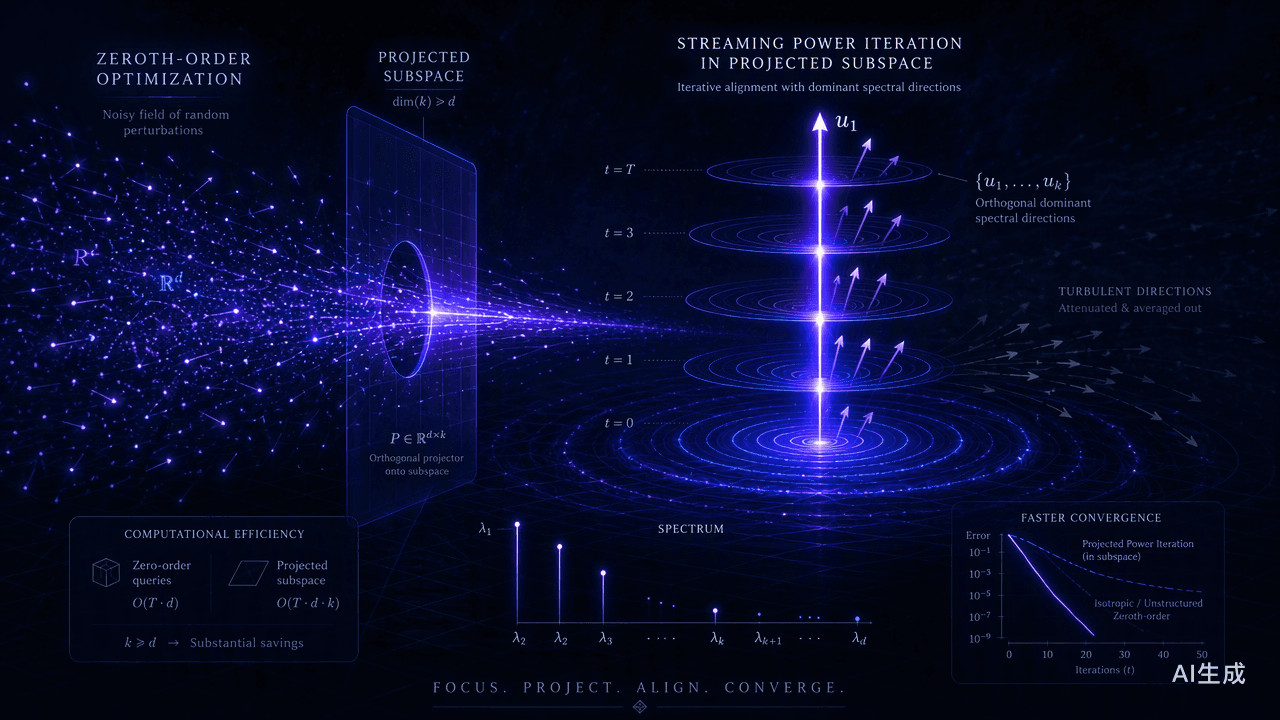
Zeroth-order (ZO) optimization has become increasingly popular and important in fine-tuning large language models (LLMs), especially on edge devices due to its ability to adjust the model to local data without the need for memory-intensive back-propagation. Recent works try to reduce ZO variance through low-dimensional subspace search, but subspace restriction alone leaves key optimization geometry under-exploited, motivating additional acceleration. In this work, we focus on the hidden layer training problem in which spectral optimizers like Muon outperform AdamW due to its ability to exploit weak spectral directions by orthogonalization. However, we have discovered that unlike in the first-order setting, full orthogonalization works poorly in the ZO setting since the gradient estimates are highly noisy and unreliable. To address this issue, we propose applying partial spectral orthogonalization to accelerate ZO optimization. To do so, we replace the iconic Newton-Schulz procedure in Muon with the faster, more concentrated power-iteration method so that it only amplifies dominant spectral directions. Furthermore, to improve the efficiency and generalization of the algorithm, we adopted a streaming variant of power-iteration that requires low variance in gradients, which was achieved through constraining our search inside a subspace obtained through the projection of momentum, echoing recent advances. Experiments on LLM fine-tuning show that our method can achieve from 1.5x to 4x the convergence speed of ZO-Muon, the current SOTA algorithm, across SuperGlue datasets in the OPT-13B model. Across different models, we also reach competitive final accuracies with less time in most cases compared with strong ZO baselines such as MeZO, LOZO and ZO-Muon. Code is available at https://github.com/MOFA-LAB/ZO-MOPI.git.


Towards Understanding the Power and Limits of the Muon Optimizer: A River-Valley Perspective
Recently, Muon has gained substantial attention as an appealing alternative to Adam-like optimizers, with many works highlighting its advantages through spectral normalization and improved conditioning. Yet this positive theoretical narrative contrasts with its empirical performance in large language model (LLM) training, where Muon’s gains over Adam/AdamW are often mixed, schedule-sensitive, and not uniformly superior. To address this gap, we develop a trajectory-level theory characterizing both the strengths and limitations of Muon. We introduce a mixed-spiked matrix sensing model whose sensing operator decomposes into signal, spike, and bulk components, capturing a mixture of anisotropic structure and long-tail information reminiscent of LLM training. On top of it, we adopted a river-valley perspective in which we view the landscape as composed of a river direction flowing to the desired solution and hill directions encoding nuisance or task-irrelevant information. In the momentum-free setting, we show that Muon moves faster along the information-bearing river direction during early optimization, but can converge much more slowly near the river bottom than gradient descent. We then extend the river-valley perspective to general nonconvex objectives with momentum by studying points on the spectral river. There, while Muon converges faster early on, its orthogonalized update removes residual scale information, making it prone to overshooting and oscillation near the target solution. Together, these results suggest that our characterizations extend beyond spiked matrix sensing and motivate switching to GD-like refinement optimizers in the final phase, rather than relying only on a fixed learning-rate schedule for Muon. We also provide preliminary evidence supporting this two-stage approach in language model training experiments.


Over-parametrization via Lifting for Low-rank Matrix Sensing: Conversion of Spurious Solutions to Strict Saddle Points
This paper studies the role of over-parametrization in solving non-convex optimization problems. The focus is on the important class of low-rank matrix sensing, where we propose an infinite hierarchy of non-convex problems via the lifting technique and the Burer-Monteiro factorization. This contrasts with the existing over-parametrization technique where the search rank is limited by the dimension of the matrix and it does not allow a rich over-parametrization of an arbitrary degree. We show that although the spurious solutions of the problem remain stationary points through the hierarchy, they will be transformed into strict saddle points (under some technical conditions) and can be escaped via local search methods. This is the first result in the literature showing that over-parametrization creates a negative curvature for escaping spurious solutions. We also derive a bound on how much over-parametrization is requited to enable the elimination of spurious solutions.
Semidefinite Programming versus Burer-Monteiro Factorization for Matrix Sensing
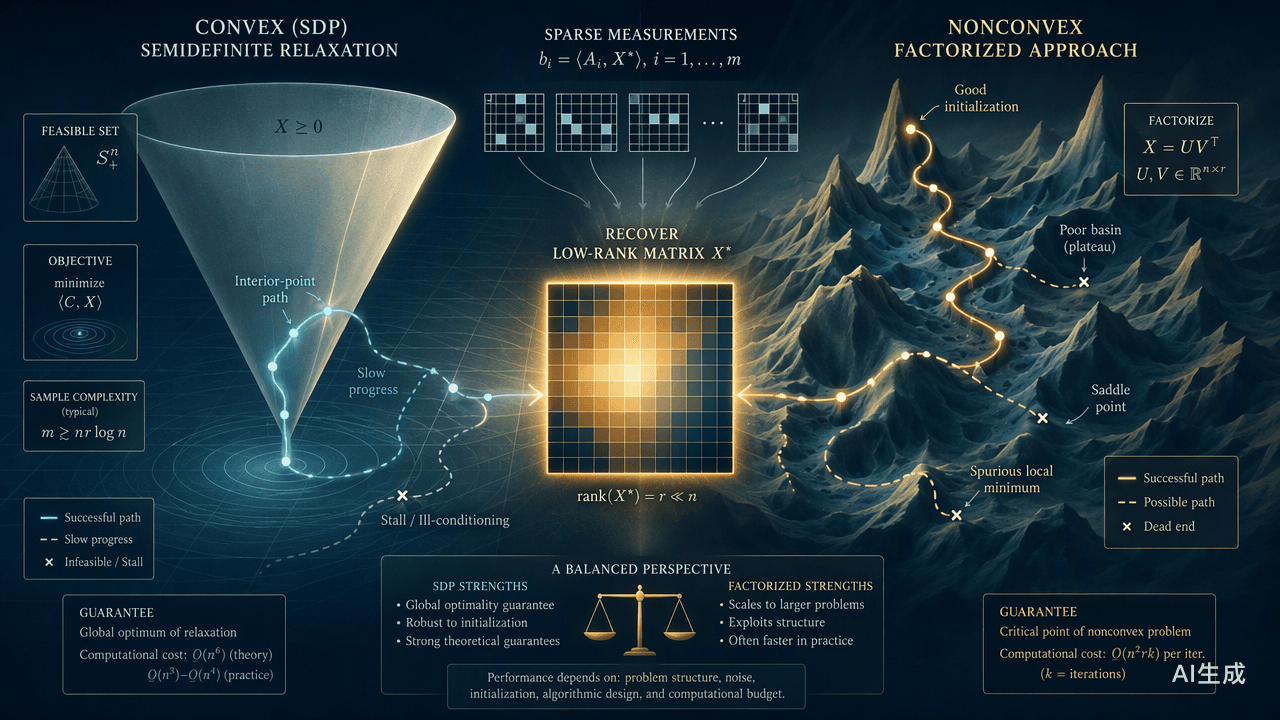
Many fundamental low-rank optimization problems, such as matrix completion, phase synchronization/retrieval, power system state estimation, and robust PCA, can be formulated as the matrix sensing problem. Two main approaches for solving matrix sensing are based on semidefinite programming (SDP) and Burer-Monteiro (B-M) factorization. The SDP method suffers from high computational and space complexities, whereas the B-M method may return a spurious solution due to the non-convexity of the problem. The existing theoretical guarantees for the success of these methods have led to similar conservative conditions, which may wrongly imply that these methods have comparable performances. In this paper, we shed light on some major differences between these two methods. First, we present a class of structured matrix completion problems for which the B-M methods fail with an overwhelming probability, while the SDP method works correctly. Second, we identify a class of highly sparse matrix completion problems for which the B-M method works and the SDP method fails. Third, we prove that although the B-M method exhibits the same performance independent of the rank of the unknown solution, the success of the SDP method is correlated to the rank of the solution and improves as the rank increases. Unlike the existing literature that has mainly focused on those instances of matrix sensing for which both SDP and B-M work, this paper offers the first result on the unique merit of each method over the alternative approach.
Absence of spurious solutions far from ground truth: A low-rank analysis with high-order losses
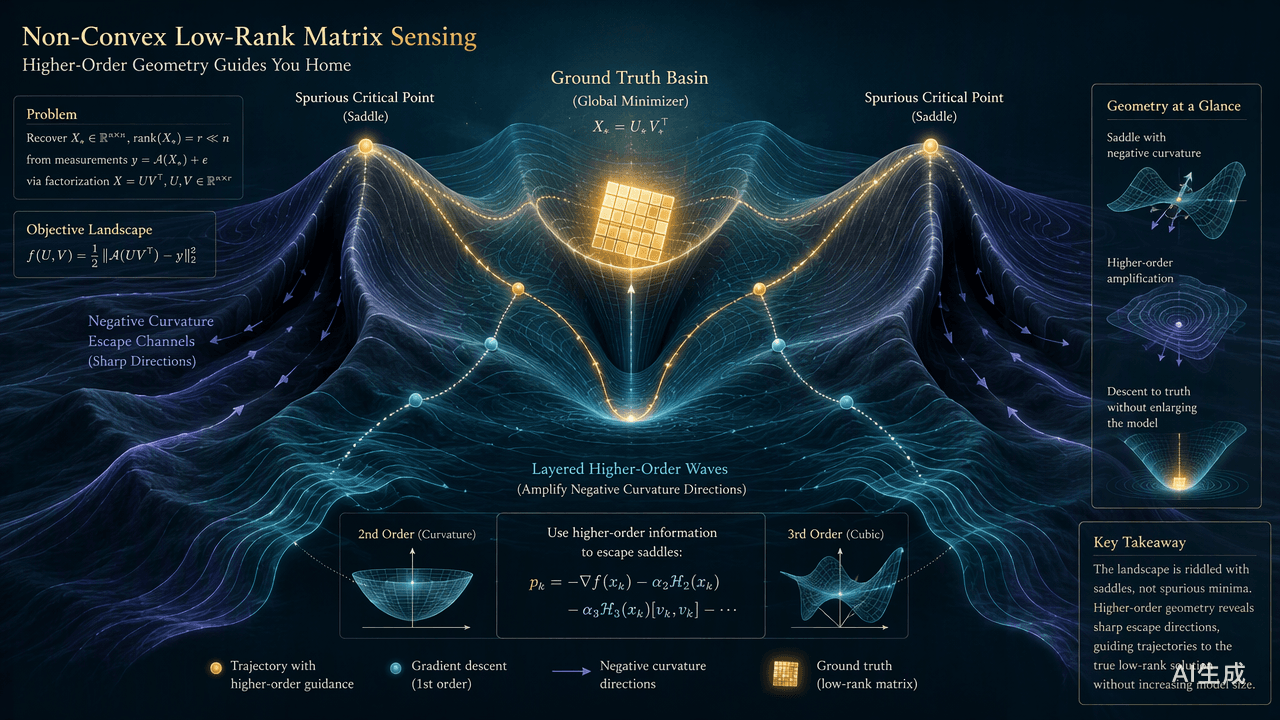
Matrix sensing problems exhibit pervasive non-convexity, plaguing optimization with a proliferation of suboptimal spurious solutions. Avoiding convergence to these critical points poses a major challenge. This work provides new theoretical insights that help demystify the intricacies of the non-convex landscape. In this work, we prove that under certain conditions, critical points sufficiently distant from the ground truth matrix exhibit favorable geometry by being strict saddle points rather than troublesome local minima. Moreover, we introduce the notion of higher-order losses for the matrix sensing problem and show that the incorporation of such losses into the objective function amplifies the negative curvature around those distant critical points. This implies that increasing the complexity of the objective function via high-order losses accelerates the escape from such critical points and acts as a desirable alternative to increasing the complexity of the optimization problem via over-parametrization. By elucidating key characteristics of the non-convex optimization landscape, this work makes progress towards a comprehensive framework for tackling broader machine learning objectives plagued by non-convexity.

Algorithmic Regularization in Tensor Optimization: Towards a Lifted Approach in Matrix Sensing
Gradient descent (GD) is crucial for generalization in machine learning models, as it induces implicit regularization, promoting compact representations. In this work, we examine the role of GD in inducing implicit regularization for tensor optimization, particularly within the context of the lifted matrix sensing framework. This framework has been recently proposed to address the non-convex matrix sensing problem by transforming spurious solutions into strict saddles when optimizing over symmetric, rank-1 tensors. We show that, with sufficiently small initialization scale, GD applied to this lifted problem results in approximate rank-1 tensors and critical points with escape directions. Our findings underscore the significance of the tensor parametrization of matrix sensing, in combination with first-order methods, in achieving global optimality in such problems.
VAMO: Efficient Zeroth-Order Variance Reduction for SGD with Faster Convergence
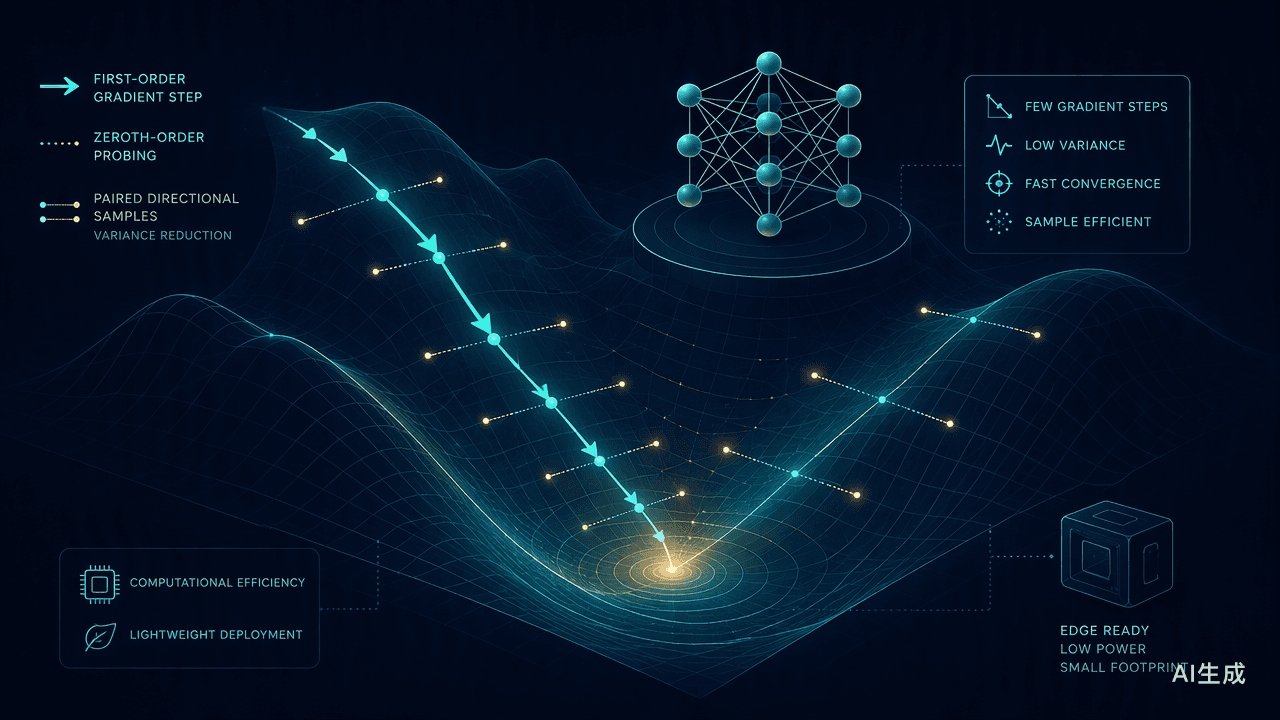
Optimizing large-scale nonconvex problems, common in deep learning, demands balancing rapid convergence with computational efficiency. First-order (FO) optimizers, which serve as today’s baselines, provide fast convergence and good generalization but often incur high computation and memory costs due to the large size of modern models. Conversely, zeroth-order (ZO) algorithms reduce this burden using estimated gradients, yet their slow convergence in high-dimensional settings limits practicality. We introduce VAMO (VAriance-reduced Mixed-gradient Optimizer), a stochastic variance-reduced method that extends mini-batch SGD with full-batch ZO gradients under an SVRG-style framework. VAMO’s hybrid design utilizes a two-point ZO estimator to achieve a dimension-agnostic convergence rate of , where is the number of iterations and is the batch-size, surpassing the dimension-dependent slowdown of purely ZO methods and significantly improving over SGD’s rate. Additionally, we propose a multi-point variant that mitigates the error by adjusting the number of estimation points to balance convergence and cost. Importantly, VAMO achieves these gains with smaller dynamic memory requirements than many FO baselines, making it particularly attractive for edge deployment. Experiments including traditional neural network training and LLM finetuning confirm that VAMO not only outperforms established FO and ZO methods, but also does so with a light memory footprint.

Topology-Aware 3D Gaussian Splatting: Leveraging Persistent Homology for Optimized Structural Integrity
Gaussian Splatting (GS) has emerged as a crucial technique for representing discrete volumetric radiance fields. It leverages unique parametrization to mitigate computational demands in scene optimization. This work introduces Topology-Aware 3D Gaussian Splatting (Topology-GS), which addresses two key limitations in current approaches: compromised pixel-level structural integrity due to incomplete initial geometric coverage, and inadequate feature-level integrity from insufficient topological constraints during optimization. To overcome these limitations, Topology-GS incorporates a novel interpolation strategy, Local Persistent Voronoi Interpolation (LPVI), and a topology-focused regularization term based on persistent barcodes, named PersLoss. LPVI utilizes persistent homology to guide adaptive interpolation, enhancing point coverage in low-curvature areas while preserving topological structure. PersLoss aligns the visual perceptual similarity of rendered images with ground truth by constraining distances between their topological features. Comprehensive experiments on three novel-view synthesis benchmarks demonstrate that Topology-GS outperforms existing methods in terms of PSNR, SSIM, and LPIPS metrics, while maintaining efficient memory usage. This study pioneers the integration of topology with 3D-GS, laying the groundwork for future research in this area.

Escaping Local Minima Provably in Non-convex Matrix Sensing: A Deterministic Framework via Simulated Lifting
Low-rank matrix sensing is a fundamental yet challenging nonconvex problem whose optimization landscape typically contains numerous spurious local minima, making it difficult for gradient-based optimizers to converge to the global optimum. Recent work has shown that over-parameterization via tensor lifting can convert such local minima into strict saddle points, an insight that also partially explains why massive scaling can improve generalization and performance in modern machine learning. Motivated by this observation, we propose a Simulated Oracle Direction (SOD) escape mechanism that simulates the landscape and escape direction of the over-parametrized space, without resorting to actually lifting the problem, since that would be computationally intractable. In essence, we designed a mathematical framework to project over-parametrized escape directions onto the original parameter space to guarantee a strict decrease of objective value from existing local minima. To the best of our knowledge, this represents the first deterministic framework that could escape spurious local minima with guarantee, especially without using random perturbations or heuristic estimates. Numerical experiments demonstrate that our framework reliably escapes local minima and facilitates convergence to global optima, while incurring minimal computational cost when compared to explicit tensor over-parameterization. We believe this framework has non-trivial implications for nonconvex optimization beyond matrix sensing, by showcasing how simulated over-parameterization can be leveraged to tame challenging optimization landscapes.

Matrix Sensing with Kernel Optimal Loss: Robustness and Optimization Landscape
In this paper we study how the choice of loss functions of non-convex optimization problems affects their robustness and optimization landscape, through the study of noisy matrix sensing. In traditional regression tasks, mean squared error (MSE) loss is a common choice, but it can be unreliable for non-Gaussian or heavy-tailed noise. To address this issue, we adopt a robust loss based on nonparametric regression, which uses a kernel-based estimate of the residual density and maximizes the estimated log-likelihood. This robust formulation coincides with the MSE loss under Gaussian errors but remains stable under more general settings. We further examine how this robust loss reshapes the optimization landscape by analyzing the upper-bound of restricted isometry property (RIP) constants for spurious local minima to disappear. Through theoretical and empirical analysis, we show that this new loss excels at handling large noise and remains robust across diverse noise distributions. This work offers initial insights into enhancing the robustness of machine learning tasks through simply changing the loss, guided by an intuitive and broadly applicable analytical framework.
Amortized Bayesian Inference on Multilevel Models of Arbitrary Structure
We develop a general method for amortized Bayesian inference on multilevel models of arbitrary structure. Given a generative model specified as a directed acyclic graph, our method automatically derives valid factorizations of the joint posterior and matching neural network architectures. The key steps, graph expansion and graph inversion, yield an inverse graph that determines how inference networks are stacked and conditioned, producing factorizations that amortize over the number of groups and the number of observations within each group. Unlike approaches that simplify the dependency structure to speed up learning or inference, our method preserves all conditional independence and exchangeability assumptions of the generative model. Across three case studies, it closely matches gold-standard samplers on models with more than 6,500 parameters while reducing inference to a near-instant forward pass once trained.